Mary Lamb · Amy Hide
Other PeopleMary Lamb / Amy Hide is the novel’s divided identity: a woman who wakes without her past and gradually discovers that the life she calls Mary’s may be the life of Amy Hide, a missing woman presumed murdered. Her trajectory turns on the difference between receiving evidence of an identity and being able to inhabit it. A photograph can establish a likeness, and other people can supply a name, but recognition arrives only through a more difficult passage into memory and selfhood.
Identity and First Appearance
Mary first appears in a stretch of parkland beneath a crooked silver birch, lying in the recent dew at 7:29 in the morning. The narrator describes her as disordered and nearly indistinguishable from the landscape around her, then insists that this appearance does not tell the whole story. The scene’s close attention to her exposed vulnerability is followed by the simple fact of waking: her eyes open to the sky, but awareness does not immediately settle into a coherent sequence.
Her thoughts arrive together rather than in order. Mary knows that memory has failed her, yet cannot fully understand what its loss entails. She can reach back as far as the previous day, but time before then dissolves into mist. The uncertainty is not merely about missing information; she does not know where the information has gone, whether it can be found again, or what a self is when its past cannot be reached. Her first foothold is the limited assurance that she is still alive.
That opening makes Mary’s name provisional. At first it functions as the only identity she can use, but the novel repeatedly puts it beside another name without immediately resolving the relation between them. The reader learns to experience the gap with her: a name may be spoken, written, or attached to a photograph before it can be recognized as one’s own.
Evidence and the Question of Amy Hide
A pink letter from John Prince gives Mary a concrete link to Amy Hide. When she turns over the lower half of the sheet, she finds a description of a missing woman: twenty-six years old, five feet seven, dark-haired, British, and with no distinguishing marks. The police believe Amy was murdered, although the letter indicates that this is not certain. The information changes the scale of Mary’s uncertainty. She is no longer dealing only with an inaccessible past; she has encountered a case in which another person’s disappearance and possible death may be connected to her own present existence.
The photograph on the other half of the letter sharpens that possibility. It shows Mary. Yet likeness is not the same as recognition: the photograph makes the question unavoidable without answering it. When Prince asks whether she is Amy Hide, Mary can only say that she does not know. His reaction conveys how strongly the name affects him, but his certainty cannot substitute for hers. The scene sets up a continuing tension between other people’s knowledge of Amy and Mary’s inability to claim that knowledge as memory.
Mary tries to gather that missing past from people associated with Amy. At one household, she introduces herself as Mary Lamb and says that she has come to ask about Amy Hide. The name produces an immediate, charged response. The woman in black turns toward her with surprised anger, while George withdraws into a small, yielding gesture; Mary recognizes in him a reflex like her own when she thinks about what she has done to Mr Botham. The household’s response is not an explanation. The woman closes the subject down, and George gives his assent, leaving Mary with a reaction whose force she can feel but whose history she cannot yet recover.
Approaching Amy’s Past
Mary also reaches toward Amy through Michael Shane. On the telephone she gives her name, then presents herself as Amy’s cousin and says that she wants to talk about her. Michael treats Amy as a subject he knows well and welcomes the prospect of meeting. Mary’s chosen explanation gives her a way into a conversation that her uncertain identity might otherwise prevent, but it does not establish that she is in fact Amy’s cousin. The distinction matters: she is actively pursuing knowledge while still lacking a secure account of her relation to the person at its center.
The search is not confined to external testimony. In a moment of distress, Mary asks whether someone has ever done something terrible in a dream and woken still believing it to be true. She says that she feels that way all the time. The comparison makes her uncertainty more than a puzzle about names or dates: the past presses on her as an experience of guilt without an available explanation. She feels the consequence before she can retrieve its cause.
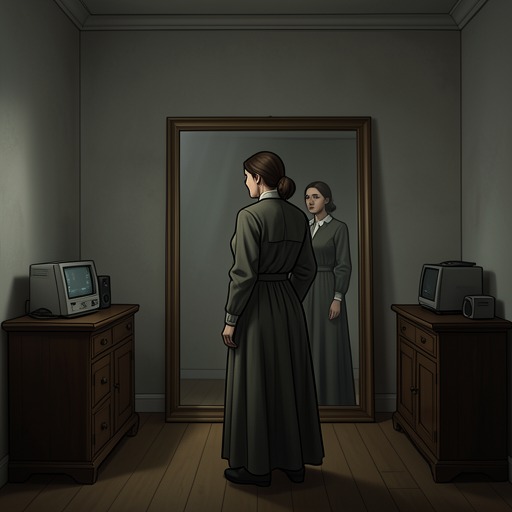
At another point, Mary faces a girl at a mirror who is busy altering her appearance. The image makes the division between observer and observed unstable: Mary approaches and identifies the girl as Amy Hide, then answers the possibility with a guarded question rather than a denial. She feels an intimate recognition, but does not yet turn it into a settled claim. The scene gives identity a visible form—her own reflection—while preserving the fear and resistance that keep recognition from being immediate.
Recognition and Return
The decisive change comes after Mary tells Jamie the story she has formed about herself: her death, her new life, her murderer, and the redeemer she believes will come for her. Jamie does not eat the meal she brings him, and Mary remains with the failure of the encounter and the sounds she makes, sounds that seem frightening even to her. Later, alone before a mirror in darkness, she hears laughter; when she switches on the light, she sees a face marked by relief and terror as well as exultation. She understands that she has crossed back through the glass, found Amy again, and become herself.
The mirror therefore shifts from a site of suspicion to one of return. Earlier, Mary could address Amy as though Amy were another girl; now the reflection registers a recovery she can claim from within. The change does not come from a new document or another person’s assertion. It follows her telling of the story she believes to be hers, however strange and incomplete that account may be. In the structure of her recovery, narration and recognition meet: by giving shape to a life that includes death, a murderer, and a hoped-for redeemer, Mary makes possible the self she had been unable to reach.
Relationships and Ending
Amy’s return to other people is marked most clearly by Baby. After examining an old photograph and finding John Prince’s words on its back, Amy walks to the door and opens it without hesitation. Baby is waiting behind the rippled glass; the two women embrace. Baby says that Amy looks very young, younger than she does. The reunion supplies recognition through a living relationship rather than through a case file: Amy is met as someone who has been absent and is now present again. Her reply is modest, but the embrace makes the recovered identity relational as well as private.
The final encounter with Mr Wrong brings Amy face to face with the person she recognizes beneath a hood or cowl. When he asks whether she remembers, she says that she does. The exchange joins what each has done to the other without erasing the harm or presenting memory as a simple cure. Amy’s recognition is now direct where it was once inaccessible, and the confrontation becomes the last threshold in the return of her past.
The ending then shifts into a scene with Amy’s mother. Amy senses that time is starting again, and her mother asks whether she is all right and whether she is herself again. Amy answers yes. The question gives the novel’s central change its plainest form: recovery is not only the return of an old name but the renewed possibility of being present in time and recognized by another person. Mary’s passage into Amy is thus neither a clean substitution nor a discovery made by evidence alone. It is a gradual movement from blankness, through other people’s incomplete accounts and her own troubled telling, toward a self she can finally acknowledge.